
5 Steps to Review AI-Generated Code Without Slowing Down
AI made writing code cheap. It didn't make reading it cheap. Here's how to keep review fast without letting "looks fine" ship.
Visakhapatnam, India A place I’ve called home
There’s a trade in AI-assisted development that nobody really warns you about. Producing code got almost free. Understanding it didn’t. Every line still has to make sense to someone before it ships.
Picture a team that adopts a coding agent on Monday. By Friday, the number of open pull requests has doubled, and the same three senior engineers are expected to review all of them. Either review becomes the bottleneck, or it quietly becomes a rubber stamp. Neither is what anyone wanted.
I don’t think the answer is to review less carefully, or to ban AI code. It’s to review differently. Here are five steps that make that practical.
Step 1: Keep the changes small, even when the AI can write big ones
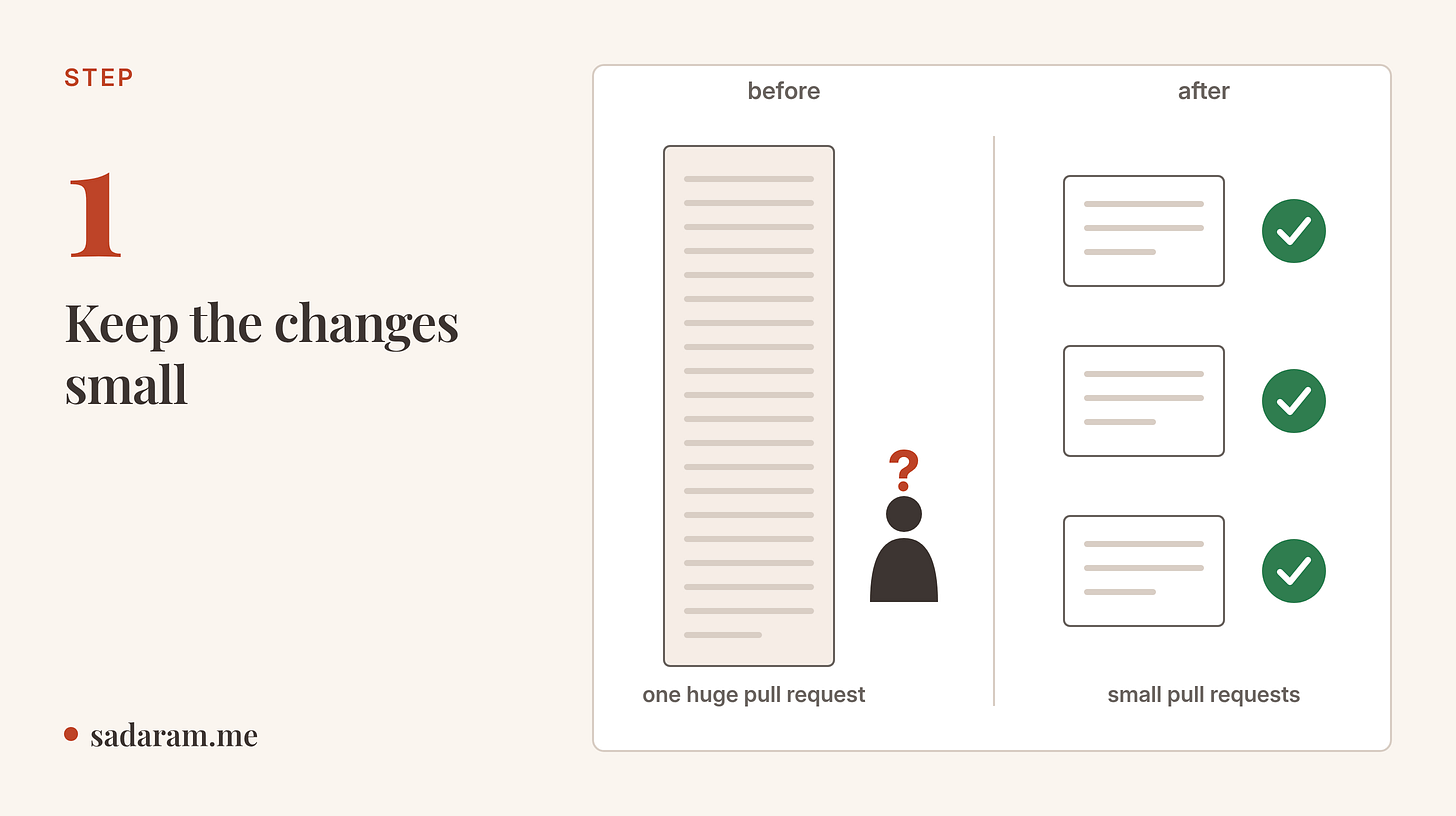
Why it matters. Google’s 2025 DORA report describes AI as an amplifier. It strengthens teams that already work well and exposes weaknesses in the ones that don’t. DORA found AI adoption is now linked to higher delivery throughput, but it’s still linked to lower delivery stability. Its AI Capabilities Model names working in small batches as a key countermeasure, because large AI-generated changes are hard to review, test and integrate safely.
How to apply it. Ask the agent for one change per pull request. Break the work down before you prompt, not after. If a diff is too big to review in one sitting, send it back and ask for it to be split.
Example. Instead of “add user export,” the work is split into three prompts: the data query, the file format, and the button that triggers it. Each pull request fits on a screen, and each can be reviewed in minutes.
Step 2: Let the machines check what machines are good at
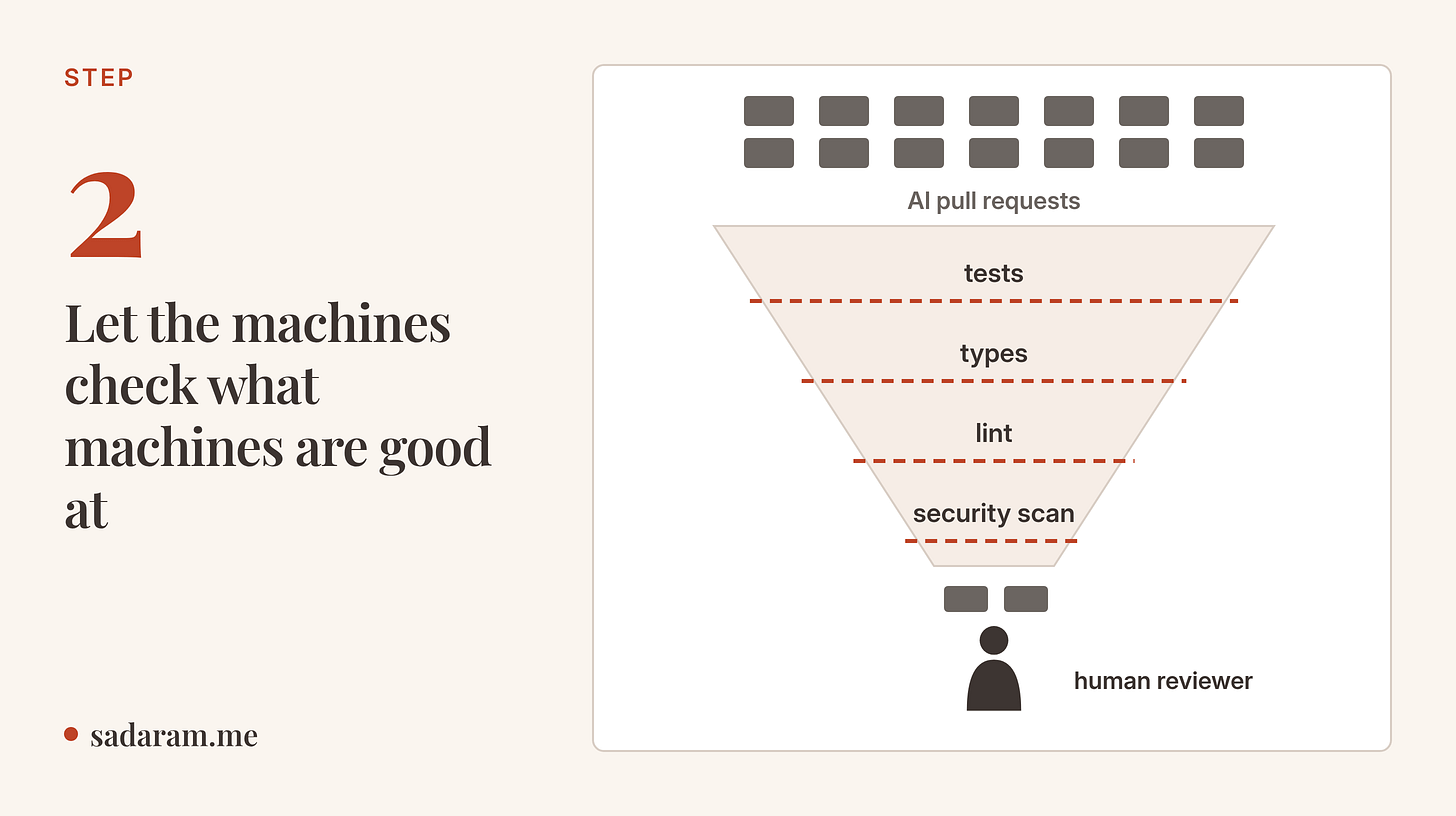
Why it matters. In Veracode’s 2025 GenAI Code Security Report, more than 100 language models were given coding tasks that could be completed securely or insecurely. In 45% of cases, they introduced a known security flaw from the OWASP Top 10. Veracode also found security performance was largely flat over time, even as models got better at writing code that runs. Its October 2025 update saw some newer reasoning models do better, but none were secure by default.
How to apply it. Don’t spend human attention on things a tool can catch. Before a person looks at an AI pull request, require the tests, type checks, linters and a static security scan to pass. Make them required checks, so “I’ll look at the CI later” isn’t an option.
Example. A team sets a branch rule: no pull request can be merged, or even assigned for review, until tests, linting and a security scan are green. Reviewers stop leaving comments about formatting and start talking about behavior.
Step 3: Review for “almost right,” not “obviously wrong”
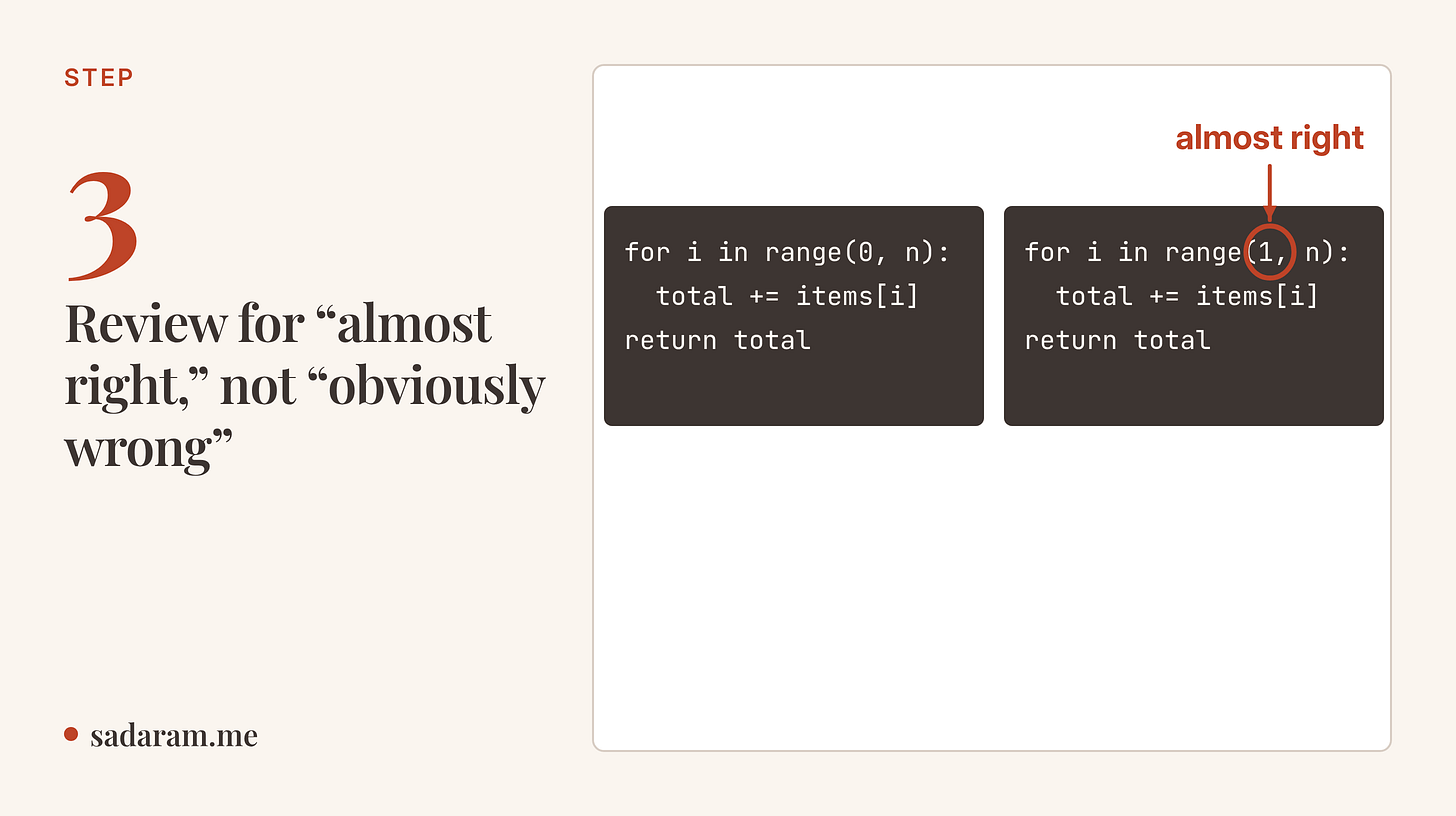
Why it matters. In the 2025 Stack Overflow Developer Survey, the biggest frustration developers reported with AI tools, cited by 66%, was “AI solutions that are almost right, but not quite.” The next biggest, at 45%, was that debugging AI-generated code takes more time. More respondents said they distrust the accuracy of AI output (46%) than trust it (33%). AI code rarely looks broken. It looks plausible, which is exactly what makes it easy to wave through.
How to apply it. Shift your review questions. Skip style and syntax, which the tools already cover. Ask: does this actually do what the ticket asked? What happens at the edges, with empty input, failures and retries? What did it change that I didn’t ask it to change?
Example. An AI-written date filter passes its tests and reads cleanly. A reviewer asking “what about time zones?” notices it compares local time to UTC, so it drops a day of records for users in some regions. No test covered it, because nobody thought to write one.
Step 4: Check every new dependency by hand
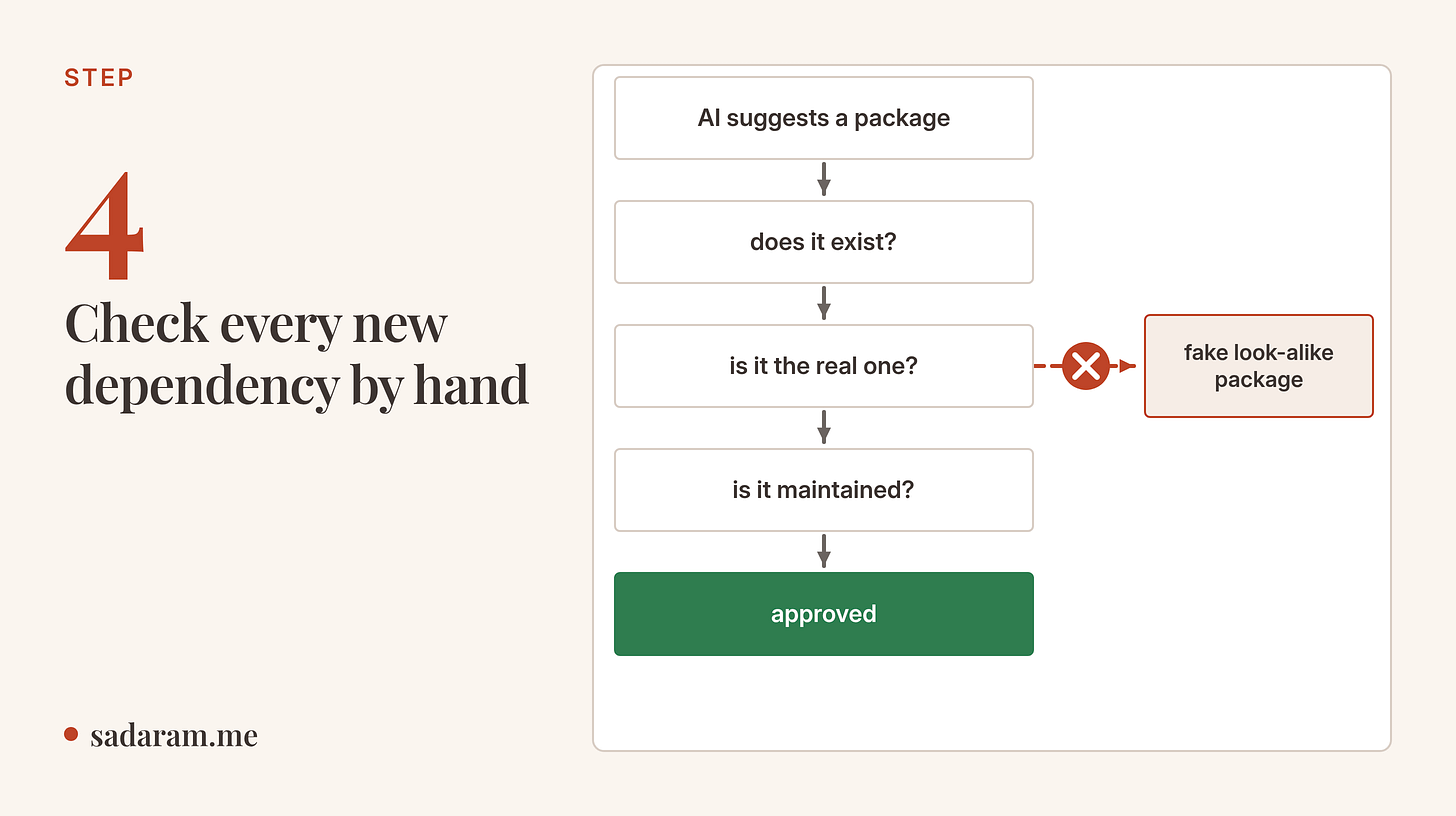
Why it matters. A USENIX Security 2025 paper tested 16 code-generating models and found they regularly recommended software packages that don’t exist. Across 2.23 million package references, 19.7% were hallucinated, including 205,474 unique fake package names. That isn’t just a bug. If an attacker registers one of those names, a hallucinated import becomes a supply-chain attack.
How to apply it. Treat any new dependency in an AI pull request as its own review item. Confirm the package exists, is the one you think it is, and is actively maintained. Watch for lockfile changes you didn’t expect, and keep automated dependency updates on rules too, like holding back major versions until someone has looked.
Example. An agent adds an import for a helper library with a convincing name. A quick check of the package registry shows it was published last week by an unknown account with no other packages. The reviewer replaces it with the well-known library the agent probably meant.
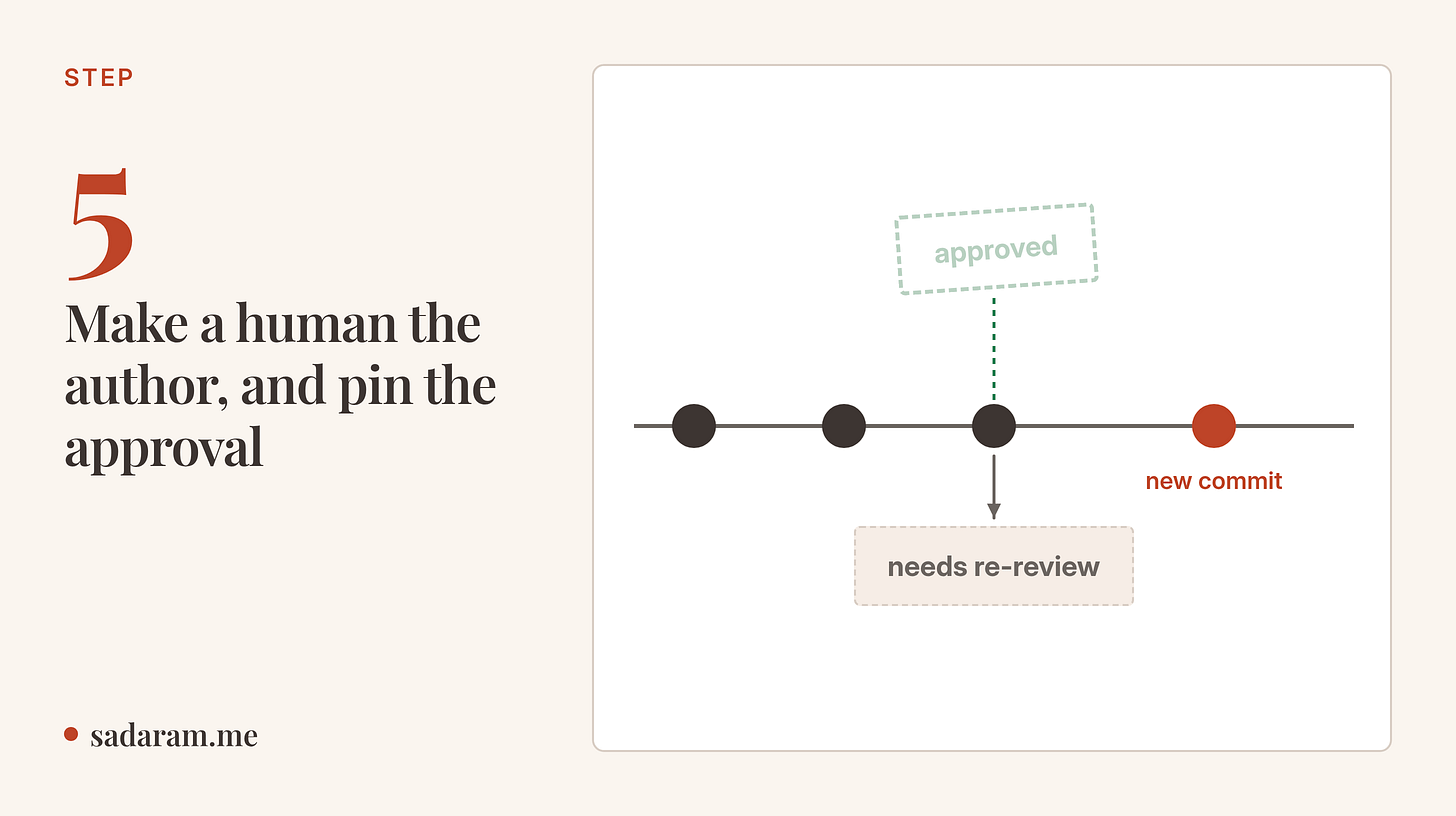
Step 5: Make a human the author, and pin the approval to what was reviewed
Why it matters. METR’s 2025 study found experienced developers were 19% slower on real tasks with early-2025 AI tools, while believing they were faster. METR now says those results are out of date and developers are likely faster today. But the gap between how fast it felt and how fast it was is still a warning: “the AI wrote it” can quietly turn into “nobody really owns it.”
How to apply it. Whoever prompts the agent owns the change. They should be able to explain it in the pull request in their own words, not by pasting the AI’s summary. And an approval should count only for the exact code that was reviewed. If new commits land after approval, the approval resets.
Example. Many code hosts can automatically dismiss approvals when new commits are pushed. Turning that on means an agent can’t slip in “one more fix” after a human has signed off.
AI didn’t remove the hard part of software. It moved it. The hard part used to be writing. Now it’s understanding what was written, quickly and honestly. Teams that redesign review for that will go faster. Teams that don’t will just ship “almost right” code at a higher speed.
What’s changed in how your team reviews AI code?